


Finishing that one origami book my aunt gave me when I was six could have been the most influential part that shaped my passions in life. Ever since then, I've been hooked. Learning through YouTube videos, design books, and eventually by creating my own models, origami kept becoming a bigger part of what I do. The OrigamiUSA Convention in New York and OrigaMIT at MIT turned into annual traditions for me, first as a student and now as a teacher.
Over time, origami shifted from something I practiced alone to something I share with others. I started running workshops, teaching younger students, and building programs that help more people experience what originally pulled me in. It’s been a constant part of my life, and it continues to shape the way I think, learn, and contribute to my community.
Right now, I mostly fold and design intermediate animal models. That’s the style I enjoy working with, because it lets me focus on clean structure and shaping without dealing with overly complicated layouts. When I design, I usually use a 22.5-degree approach, which means building the crease pattern around angles that are multiples of 22.5°. It keeps the geometry manageable while still giving enough flexibility to get the shapes I want.
My dolphin crease pattern is a simple example of how I use this style. It’s straightforward, but it shows how 22.5 techniques can create natural proportions without needing a huge number of folds:


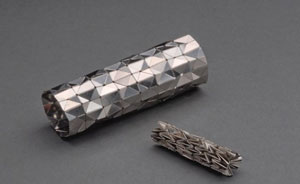
Origami shows up in engineering more than most people realize. Foldable solar arrays, deployable space structures, and compact medical tools all use ideas that come from folding. It's the same problem folders have solved for centuries: how to pack the most function into the least material and space.
Folding has shaped how I approach engineering, too. It teaches you to break things into steps, plan clean layouts, and visualize how something changes as you move through each stage. I use that same approach when I'm CADing parts or figuring out how a mechanism should move for Science Olympiad.
To learn more about my work in origami and engineering, check out Research
I spend a lot of time teaching and sharing origami with different groups in my community. I run workshops for younger students, help lead my school’s origami club, and teach at my local library during the summer. I visit a nearby senior residence every other Saturday, which has become one of my favorite places to teach because the conversations and pace there are completely different from anywhere else. I’m involved with the OrigamiUSA Junior Board as well, where I help support and connect younger folders across the community.
To see more of my involvement, check out Community & Leadership
Reading anything from Robert J. Lang, but especially this book is essential to getting started with design. Every single YouTube video or any paper on origami design always has something derived from this book. I love this book because it gives a broad overview of most of the techniques and ideas you need to know to design your own origami.


This book is great for building the intuition behind design. What's unique is that it introduces you to the theory along with a model, and then gives you hard challenges to complete to stretch your thinking on how to bring the theory to life. Afterwards, it gives an explanation of how the author completed the challenge and exactly how they went about doing it.
This book by Satoshi Kamiya introduced me to complex and supercomplex origami models. With the massive and tedious models it contains, I spent hours collapsing, shaping, and attempting to understand them, which got me to appreciate both the art and the science behind creating lifelike models. What I love about this book is that Kamiya isn't scared to include models that might be too complex for many people, pushing the boundaries of what's possible!

If you want to see more of my work, head over to the gallery.

